
Key Takeaways
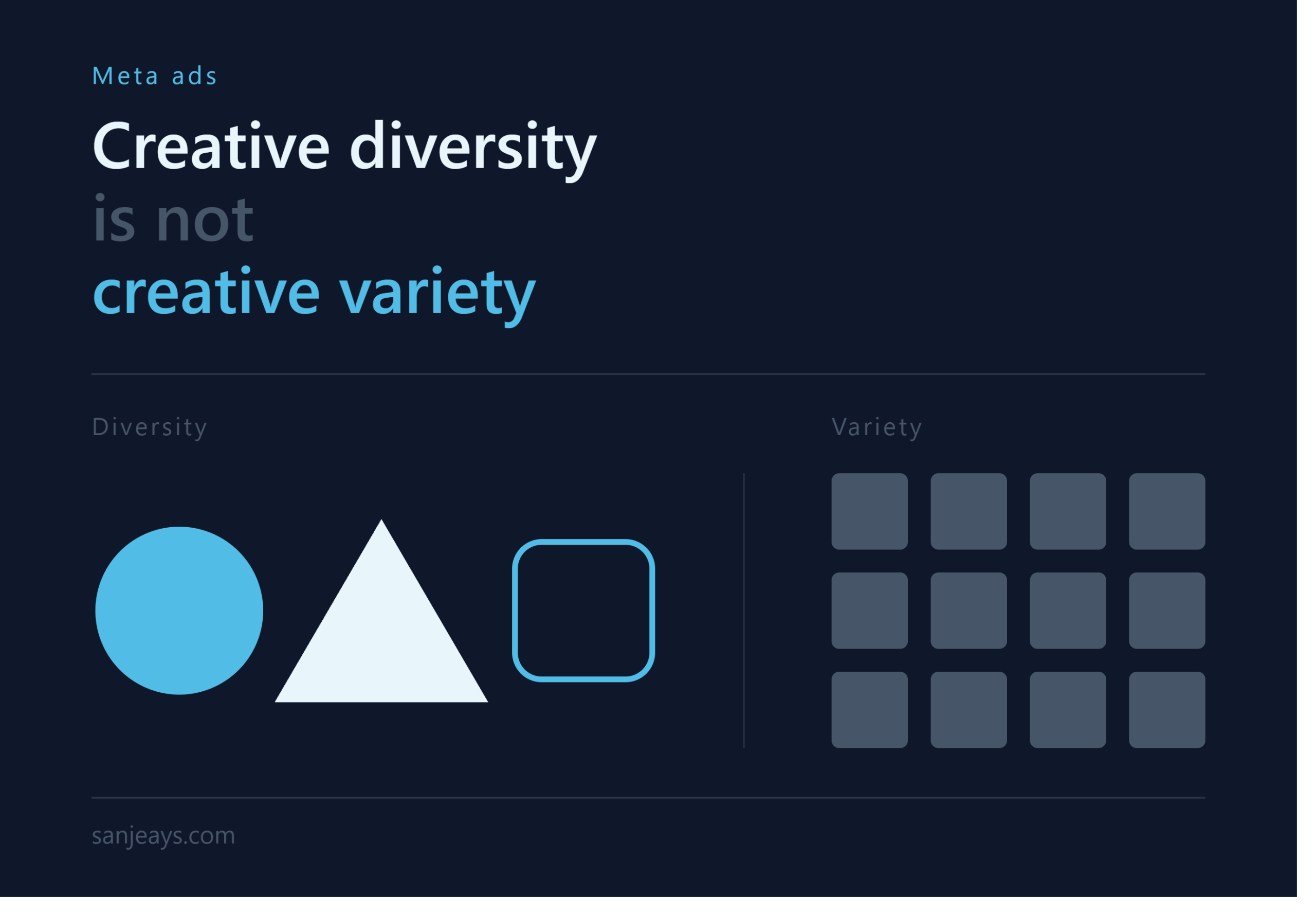
- Creative Diversity on Meta Ads is a set of distinct assets built for different personas, pain points, or use cases. Creative Iteration (or creative variety) is changing one element of an asset that still speaks to the same audience.
- Meta updates like Andromeda and Hierarchical Interest Representation have pushed creative to the front of the targeting conversation, because the algorithm now does the audience matching that media buyers used to do manually.
- A healthy Meta Ads account runs both: diverse concepts at the top, iterations underneath each concept.
Meta has been pretty busy in the last few quarters rolling out one update after another to its algorithm ranging from Andromeda (every DTC CMO’s 2nd favorite buzzword after AI) to the newer Hierarchical Interest Representation which deals with improving its ad AI to better understand people’s interests and match them with relevant products, especially for purchase and lead campaigns with limited conversion data.
One thing you may have observed with all these recent updates is that Creatives play a more crucial role than ever in the ecosystem. If you’re not leading targeting with creatives on Meta, your brand now has a higher chance of being left behind than anyone else.
It is critical to understand that spinning 50 variations of the same creative concept is not “True Creative Diversity” it is just more noise. Understanding what genuine Creative Diversity is will be the secret sauce that may set your campaigns apart from the thousands if not millions of mediocre campaigns that get launched daily on Meta.
Creative Diversity vs Creative Iteration: What Is the Difference?
Most brands use “Creative Diversity” and “Creative Variety or Iterations” interchangeably, they shouldn’t.
- Creative Diversity is when a brand produces distinct campaign assets tailored towards different personas or pain points.
- Creative Iteration is when you take one such distinct asset and create variety by changing an element on it but still addressing the same persona, use case or audience.
| Creative Diversity | Creative Iteration | |
| What actually changes | The persona, pain point, or use case being addressed | A single element inside the same concept |
| Purpose | Widens the number of distinct audiences your account can be matched to | Improves performance within an audience you already reach |
| What it feeds the algorithm | Genuinely different signals across separate interest clusters | Incremental performance signals on an existing concept |
| Risk when it is the only thing you do | Concepts never get optimized and are killed too early | Creative fatigue and repetitive signals |
A Real World Example: Creative Diversity for a Calgary Condo Launch
Let’s examine this with a real world example.
- Imagine a new home builder working on promoting a new condo project in Calgary. For them, Creative Diversity could be illustrated as follows:
- Concept A (downsizers): A set of polished, corporate-esque ad assets featuring empty nesters or retirees who may be looking to downsize from a larger detached home to a smaller accessible house as part of their retirement, with accessibility and low maintenance as the USP.
- Concept B (first-time buyers): A set of UGC style assets that talk to younger, first-time home buyers, featuring trendy real estate content creators who do fad house tours, with a focus on affordability.
- Creative Iteration here could be just changing the hook of the video or the headline on the image to something else in any of the above cases, but continuing to address the same audience.
Two concepts, two personas, two different USPs. Everything underneath each concept is iteration.
I spoke about this in great detail with my friends at the Calgary Marketing Association on their Spotlight podcast which you can listen to anywhere you get your podcasts or watch below straight from YouTube.
Why Does Creative Diversity Matter More After Meta Andromeda?
Creative Diversity matters more now because Meta’s recent updates have moved the targeting decision away from the media buyer and towards the ad itself. Andromeda sits at the retrieval stage of the ads system, which is the step that decides which ads even get considered for a given person before ranking happens. Hierarchical Interest Representation then works on matching interests to relevant products, particularly in purchase and lead campaigns where conversion data is thin.
The practical takeaway for advertisers is the same in both cases: the creative is now the targeting input. If every asset in your account speaks to the same person in the same tone about the same benefit, you are handing the system one narrow signal and asking it to find scale that isn’t there.
How Do You Build Creative Diversity Into a Meta Ads Account?
Start from the buyer, not from the asset. A simple way to structure it:
- List the distinct personas or pain points that can realistically buy from you.
- Write one core message and USP for each persona, not one message stretched across all of them.
- Assign a format and tone per persona, since a downsizer and a first-time buyer rarely respond to the same production style.
- Build the concept, then iterate hooks, headlines, and thumbnails inside that concept. This is the stage where colour-pop creative, motion-first formats, and lo-fi UGC earn their keep.
- Judge each concept on its own, and only kill a persona once its iterations have had a fair run.
Frequently Asked Questions
Is Creative Diversity the same as making more ads? No. More ads only create diversity if they address different personas, pain points, or use cases. Fifty edits of one concept is volume, not diversity.
How many creative concepts should a Meta Ads account run? There is no fixed number, but the useful benchmark is the number of genuinely distinct buyers you can serve. If you can name three different personas with three different reasons to buy, you need at least three concepts.
Does Creative Iteration still matter after Andromeda? Yes. Iteration is how a working concept gets better and how you fight creative fatigue. It just cannot substitute for diversity, because it never introduces a new audience signal.
Comment
Hey great post on distinguishing the two concepts but that got me thinking.
I see the same creative concepts with amazing global brands like Coca Cola or Kit Kat, does this phenomena not apply for them? Or is it accurate to say that consistency outperforms diversity?